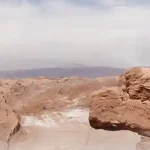
The Black Desert
The region known as the Black Desert or Ḥarrat al-Shām (Arabic: حَرَّة ٱلشَّام), spans southern Syria, Eastern Jordan and the northern Arabian Peninsula and is characterized by rocky, basaltic terrain. Covering approximately 40,000 km2 (15,000 sq mi), this area extends across modern-day Syria, Jordan, Israel, and Saudi Arabia. The vegetation consists of open acacia shrubland with juniper patches at higher elevations. Humans have inhabited the Harrat since at least the Late Epipalaeolithic period (c. 12,500–9500 BCE), with one of the earliest known sites being Shubayqa 1 (occupied c. 12,600–10,000 BCE). At this site, archaeologists discovered the remains of the oldest known bread.
The Harrat volcanic field is a result of tectonic activity that took place from the Oligocene to the Quaternary period, forming a group of volcanic fields. This area is the largest of its kind on the Arabian Plate and includes over 800 volcanic cones and approximately 140 dikes. The volcanic activity started during the Miocene and continued during the late-Pleistocene and Holocene periods. It has even been known to erupt in recent history.
The Harrat Ash Shamah volcanic field extends across the northern and Syrian part of the region, along with other fields like Jabal al-Druze, al-Safa, and Dirat al-Tulul. The Saudi Arabian part of the Harrat Ash Shamah volcanic field is around 210 km long and 75 km wide, extending in a northwest-southeast direction on the northeastern side of the Sirhan Valley. Jabal Al-Amud, which is 1,100 meters high, marks the highest point of the field. This volcanic field is located in the Tabuk Region of northwest Saudi Arabia and is one of many Quaternary volcanic fields that run parallel to the Red Sea coast.
Jawa, situated in the arid Harrat al-Shamah region of Eastern Jordan, is home to Jordan’s earliest proto-urban settlement dating back to the late 4th millennium BC (Early Bronze Age). This area is known for its dry climate.